Gold Market in 2026: China, Sanctions and Financial Power
Explore the gold market in 2026, including transparency concerns, China's strategic role, central bank reserves and the impact of international sanctions.

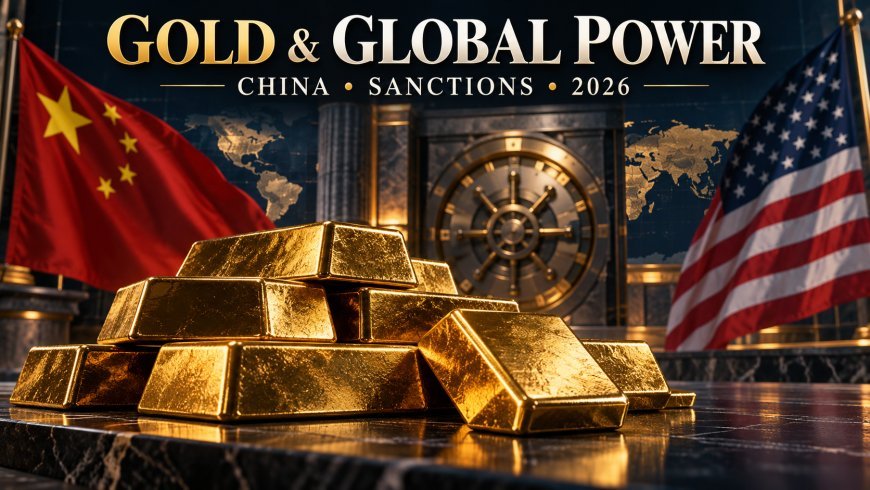
Gold Market in 2026: China, Sanctions and the Struggle for Financial Power
Gold is more than a financial asset. Its ownership, location and accessibility raise important questions about national sovereignty, international sanctions and the security of central bank reserves.
The gold market in 2026 raises a question that extends beyond investing: how effectively can a country protect its wealth when international confrontation threatens its access to the financial system?
Behind bullion purchases and reserve-management decisions lies a debate about trust and dependence. Gold offers a useful lens for examining how governments prepare for situations in which economic relationships no longer guarantee political cooperation.
Understanding that debate requires separating verified information from interpretation. Limited transparency deserves scrutiny, but it does not, by itself, establish financial manipulation or prove that a global economic crisis is inevitable.
One of the most striking figures in discussions about gold is the estimated $14 trillion value of the financial physical gold market.
The World Gold Council describes this market as encompassing bars, coins, gold-backed exchange-traded funds, central bank reserves and over-the-counter investments. The estimate concerns the value of existing holdings, rather than the amount traded during a single year. [1]
This distinction changes the interpretation. The total value of a country's housing stock is different from the value of homes sold annually. Likewise, the value of accumulated gold holdings is not equivalent to annual trading turnover.
The more useful questions concern the information available about ownership, transactions and changes in demand. A large market can contain meaningful gaps in public information without its entire value being unaccounted for.
Wholesale gold trading takes place through different structures. Some transactions occur on exchanges, while others are negotiated directly between counterparties.
These bilateral transactions are known as over-the-counter, or OTC, trades. They allow participants to customize contract terms and execute large transactions discreetly. The World Gold Council identifies lower transparency and counterparty credit exposure as characteristics of this market structure. [2]
Confidentiality can serve a commercial purpose. An institutional buyer may prefer not to reveal a large order before completing it, because other traders could react to that information.
For outside observers, however, limited disclosure makes it harder to identify who is accumulating gold and what is motivating the purchase. Analysts may observe market activity without being able to establish the identity of the ultimate owner.
A lack of full public visibility should not automatically be equated with an absence of regulatory obligations. Limited disclosure, unlawful conduct and price manipulation are separate issues that require separate evidence.
The World Gold Council reported approximately 327 tonnes in its “OTC and Other” category during the second quarter of 2026, bringing the first-half total to about 571 tonnes. [3]
These figures demonstrate the importance of this demand category. They do not establish that all the metal was secretly purchased by governments.
Classification changes also matter. The second-quarter update included a reclassification of demand previously attributed to central banks into the OTC category. [4]
For geopolitical analysis, the implication is methodological: provisional estimates should not be treated as definitive proof of a particular government's strategy.
Officially reported purchases, estimates of unreported demand and private-sector acquisitions represent different kinds of evidence. Combining them without explanation can produce a misleading picture of state behavior.
The geopolitical debate surrounding reserves took on additional significance after Russia's full-scale invasion of Ukraine in 2022.
The European Union and its partners restricted transactions involving the Russian central bank's reserves and assets. According to the Council of the European Union, approximately €260 billion in Russian central bank assets were immobilized across G7, EU and Australian jurisdictions. [5]
A strategic interpretation of this precedent is that ownership and access are not the same thing. A government may retain legal ownership of an asset while being unable to transfer or use it because of restrictions imposed in another jurisdiction.
From the perspective of a reserve manager concerned about possible sanctions, this creates questions that extend beyond expected returns:
This interpretation does not establish that every central bank buys gold for the same reason. It explains why jurisdiction and custody can become important considerations in reserve management.
China's role attracts attention because decisions about reserves, trade and financial autonomy carry broader strategic implications. Nevertheless, individual gold purchases cannot reveal a country's entire monetary strategy.
As an analytical possibility, accumulating gold can help distribute risk across different assets and reduce particular dependencies. That does not, on its own, demonstrate an intention or ability to replace the US dollar.
Gold can serve as a reserve asset. An international currency must also support payments, contracts, lending and financing across a wide range of markets. Holding more metal and building an alternative monetary system are therefore different undertakings.
Another distinction concerns the buyer. Purchases by Chinese households, businesses, investment funds and public institutions should not automatically be counted as central bank acquisitions.
Where the final owner is unknown, a rigorous assessment should preserve that uncertainty. Attributing every observed flow to a single state strategy would go beyond the available evidence.
Physical gold held domestically can reduce certain dependencies on foreign custodians. Its practical usefulness, however, also depends on whether the owner can mobilize it.
A government seeking to turn bullion into usable resources needs willing counterparties and workable arrangements for authentication, custody, settlement and, where necessary, transportation.
The strategic implication is that financial autonomy depends on both possession and usability. Holding an asset does not guarantee that it can be sold quickly, at an acceptable price, under every political condition.
Gold may expand a country's options, but it does not eliminate the importance of trading relationships, market access or the willingness of other institutions to transact.
Incomplete information can make risk assessment more difficult. It is not sufficient evidence, by itself, to diagnose a global crisis.
Such a conclusion would require analysis of credit conditions, banking-system resilience, economic activity and the functioning of payment and funding markets.
Gold-price movements also require context. An increase should not automatically be interpreted as proof that the financial system is approaching collapse.
The same discipline applies to price forecasts. Projections are conditional scenarios built on assumptions. An institution's reputation does not turn its forecast into a guaranteed outcome.
For most households, the connection is indirect. Geopolitical tensions can encourage demand for perceived safe-haven assets while also disrupting energy markets, transportation or financing.
When those pressures reach businesses and consumers, they may influence prices, employment and investment decisions. This does not mean that a higher gold price independently causes higher food prices. Both developments can reflect shared underlying pressures.
For an open economy such as the Dominican Republic, a practical assessment would examine imports, exchange rates, fuel costs, tourism and financing conditions. Gold-market developments should be considered alongside those channels, rather than used as a standalone forecast of household costs.
A useful framework for monitoring the relationship between gold and geopolitical power includes:
The gold market in 2026 deserves attention because it connects financial decisions with concerns about sovereignty and access to wealth. For governments, the critical question extends beyond what their reserves are worth: it also concerns who holds them, which rules apply and whether they will remain usable during a crisis.
It is the part of the market in which counterparties negotiate transactions directly instead of executing them through an exchange. It provides flexibility but generally offers less public transparency. [2]
No. The cited estimate describes the value of the financial physical gold market. It does not establish an accounting loss or an annual volume of clandestine transactions. [1]
Not necessarily. An institution can diversify its reserves into gold while continuing to hold dollar-denominated assets. A purchase alone does not demonstrate a monetary break.
No. Limited information can complicate oversight and analysis, but demonstrating manipulation requires evidence of specific conduct.
Not necessarily. Its usability depends on factors such as access to counterparties, authentication, settlement arrangements and applicable restrictions.
What Does the $14 Trillion Gold Market Figure Mean?
Why Is Part of the Gold Market Less Transparent?
What Do the Gold Demand Figures for 2026 Show?
How Russian Sanctions Changed the Debate About Reserve Security
China, Gold Reserves and the Limits of Dollar Diversification
Can Gold Protect a Country From Financial Sanctions?
Does Gold Market Opacity Signal a Global Economic Crisis?
How Can Gold-Related Geopolitical Tensions Affect Households?
What to Watch in the Gold Market
Frequently Asked Questions
What is the OTC gold market?
Does the $14 trillion estimate represent missing money?
Does buying gold mean abandoning the US dollar?
Does limited transparency prove manipulation?
Is domestically stored gold always immediately usable?
What's Your Reaction?
 Like
0
Like
0
 Dislike
0
Dislike
0
 Love
0
Love
0
 Funny
0
Funny
0
 Angry
0
Angry
0
 Sad
0
Sad
0
 Wow
0
Wow
0