
Strait of Hormuz Crisis 2026: Iran and Global Oil Risks
Explore the Strait of Hormuz crisis in 2026, shipping attacks, Iran’s strategic leverage and the risks to global oil supplies and energy security.

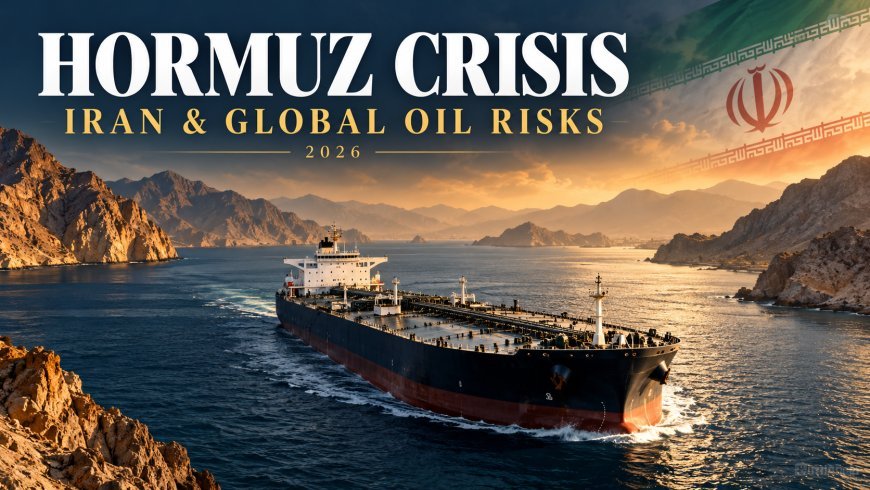
Attacks on commercial shipping have made the Strait of Hormuz a focal point of the Middle East conflict. Understanding the crisis requires separating verified incidents from inflated claims and examining how maritime insecurity becomes economic and diplomatic leverage.
Reporting cutoff: .
A narrow shipping corridor can influence the global economy without being completely sealed. When shipowners question whether their vessels can cross safely, the consequences extend beyond damaged hulls: cargo schedules become uncertain, commercial decisions change and governments face pressure to respond.
That is the central strategic issue in the Strait of Hormuz crisis in 2026. Maritime disruption can impose costs even when some traffic continues. However, the seriousness of the situation does not justify treating every dramatic claim as established fact.
United Kingdom Maritime Trade Operations, or UKMTO, published multiple October incident notices describing vessels struck by unidentified projectiles in and around the Strait of Hormuz. Some reports describe fires or damage, while others note that crews were safe or that vessels continued their passage. Several notices were issued after the incident occurred. [1]
These reports establish a serious maritime threat. They do not support treating all reported incidents as ships sunk, nor do they independently establish responsibility for every attack.
The sources reviewed for this article do not establish the claim that Iran attacked 70 merchant vessels between October 1 and October 18. That number should therefore not be presented as a confirmed total.
Suspected underreporting cannot be converted into a reliable count simply by doubling known incidents. A defensible total requires a defined geographic area, an incident-by-incident record and checks for duplicate reports and subsequent updates.
Terminology matters as well. A threatened vessel, a damaged ship and a sunken tanker represent different outcomes. Combining them into a single dramatic category obscures the actual severity of each event.
Hormuz connects the Persian Gulf with the Gulf of Oman and the Arabian Sea. Its importance comes from the concentration of energy exports passing through a geographically constrained waterway.
As a historical baseline, the US Energy Information Administration estimated that approximately 20 million barrels of oil per day passed through the strait in 2024, equivalent to around 20% of global petroleum liquids consumption. Roughly one-fifth of global liquefied natural gas trade also used the route that year. [2]
Those figures describe pre-crisis exposure, not current October 2026 throughput. They also correct a recurring exaggeration: Hormuz did not carry half of all oil consumed worldwide.
Its strategic significance does not require that larger claim. A disruption affecting a substantial share of internationally traded energy is enough to create difficult choices for producers, buyers and governments.
From a strategic perspective, the ability to make shipping less predictable can be valuable even without permanently stopping it. Commercial operators respond to expected losses as well as actual damage.
Reuters reported on October 14 that two senior Iranian officials described changes in shipping-attack tactics intended to sustain oil prices and influence the US midterm elections. This is an attributed account of their stated intentions, rather than proof that every incident serves an identical plan. [3]
The analytical implication is that maritime pressure can link military activity to economic and political bargaining. A government may seek to make continued confrontation more costly for its adversaries.
Such a strategy also carries risks. Disruption can harm trading partners, weaken diplomatic support and expose the country applying pressure to further military or economic retaliation.
The capacity to impose costs should therefore not be confused with complete control over the eventual outcome.
Oil markets respond to both physical availability and expectations about future supply. Shipping insecurity can influence the delivered cost of energy through several channels:
These mechanisms are not a guarantee of continuously rising prices. Demand weakness, inventory releases, alternative supplies or diplomatic progress can offset some of the pressure.
A statement that “oil costs $160 a barrel” is incomplete without identifying the crude grade, delivery location, contract and observation time. A particular physical cargo price is not necessarily the price of Brent or West Texas Intermediate.
This article does not adopt the transcript's $150–$160 price claim because the material reviewed does not establish a clearly identified, independently verified benchmark for it.
Geography places a practical limit on maritime workarounds. A vessel loading inside the Persian Gulf cannot avoid Hormuz merely by sailing around the Cape of Good Hope. It must first reach waters outside the Gulf.
This distinguishes a Hormuz disruption from a Suez Canal or Red Sea diversion. Sailing around southern Africa can bypass the latter routes, but it does not create another maritime exit from the Persian Gulf.
Saudi Arabia and the United Arab Emirates have pipeline infrastructure that can move some oil to export terminals outside Hormuz. The EIA identifies these as partial alternatives, with practical capacity limits. [2]
Any assessment must distinguish a pipeline's nominal capacity from its available capacity. Infrastructure already carrying oil cannot offer its entire rated throughput as additional emergency capacity.
Rerouting also redistributes vulnerability. Concentrating exports through another terminal or corridor can create new dependencies rather than eliminate security risks.
On October 18, Reuters reported that Iranian Foreign Minister Abbas Araqchi said a proposal to reopen Hormuz within seven days remained available. The report also described disagreements over the terms of negotiations. [4]
The statement demonstrates a publicly expressed negotiating position. It does not establish that an agreement has been reached or that safe passage can be restored on that timetable.
Domestic political incentives may influence how leaders communicate military operations. Nevertheless, claims that a leader deliberately seeks war to cancel elections require specific evidence. Electoral pressure alone cannot establish that intention.
The same standard applies to allegations of secret arrangements for symbolic bombing missions. Without authenticated documentation or adequate independent corroboration, they should remain allegations.
A professional geopolitical assessment examines incentives while maintaining a clear boundary between plausible interpretation and verified conduct.
The following scenarios are analytical possibilities, not predictions or probability estimates.
Diplomatic arrangements could reduce incidents and allow more predictable passage. The strongest evidence would be sustained operational improvement: fewer attacks, more completed transits and greater commercial confidence.
Shipping could continue under uneven conditions, with periods of increased danger. This would preserve some trade while leaving operators exposed to delays and changing costs.
Escalation affecting ports, pipelines or processing facilities could reduce the usefulness of alternative routes. The economic impact would depend on the assets affected, repair times and the availability of replacement supplies.
Households do not need to purchase crude oil directly to face consequences from energy disruption. Fuel costs can influence transportation, electricity generation and business expenses.
The scale and timing of any effect depend on local factors, including exchange rates, taxes, subsidies, inventories and supply contracts. A change in international crude prices does not translate immediately or uniformly into retail prices.
For import-dependent economies such as the Dominican Republic, a useful assessment would monitor the fuel import bill, freight costs and domestic pricing policies together. A maritime headline alone cannot establish the eventual increase in household expenses.
The sources reviewed for this article do not establish that total. Confirmed incidents should be counted individually, with updates checked for duplication.
No. The EIA's 2024 baseline placed flows through the strait at about one-fifth of global petroleum liquids consumption. [2]
Not if they are starting inside the Persian Gulf. The Cape of Good Hope does not provide another maritime exit from the Gulf.
No. Reports can describe threats, impacts, fires, damage or sinking. These outcomes should not be treated as interchangeable.
Not necessarily. Commercial confidence, vessel schedules, inventories and infrastructure conditions would also influence the recovery.
What Do Verified Shipping Reports Confirm?
Has Iran attacked 70 ships in October?
Why Is the Strait of Hormuz Important?
Iran's Strategic Leverage: Disruption Without Total Closure
How Shipping Insecurity Can Affect Oil Prices
Why a price claim needs a benchmark
Why Alternative Routes Cannot Simply Replace Hormuz
Diplomacy, Domestic Politics and Escalation Risks
Three Scenarios to Monitor
1. Negotiated improvement in maritime access
2. Persistent disruption with intermittent passage
3. Wider attacks on energy and transport infrastructure
What the Hormuz Crisis Means for Consumers
Frequently Asked Questions
Have 70 ships been confirmed attacked in October 2026?
Does half of the world's oil pass through Hormuz?
Can ships bypass Hormuz by sailing around Africa?
Do all shipping incidents mean a vessel has sunk?
Would an agreement immediately normalize energy prices?
The central issue in the Strait of Hormuz crisis is the reliability of passage. Military announcements and diplomatic statements matter, but durable improvement must ultimately be demonstrated by safer voyages, dependable deliveries and reduced uncertainty for crews and commercial operators.
What's Your Reaction?
 Like
0
 Dislike
0
 Love
0
 Funny
0
 Angry
0
 Sad
0
 Wow
0