Trump and Power: The Deep Divide Splitting America
The United States faces growing political, economic, and cultural polarization under Donald Trump’s second administration. Explore the causes and consequences of America’s deepening divide.

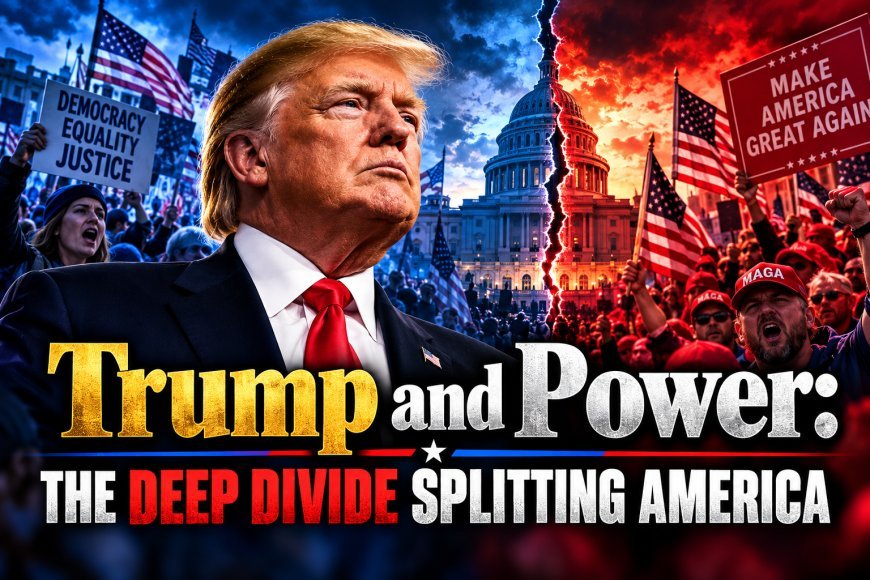
The United States remains one of the world's leading economic, military, and technological powers. Yet behind its global influence lies a deeply divided society, where millions of citizens hold opposing views about the country's future, the role of government, and the meaning of democracy.
Donald Trump's return to the White House on January 20, 2025, brought these divisions back to the center of American politics. For his supporters, his second presidency represents an opportunity to restore jobs, reduce bureaucracy, strengthen border security, and give a voice to communities they believe have been neglected by political elites. For his critics, his policies create uncertainty, threaten public programs, and intensify tensions between social groups.
However, America's divisions cannot be explained by one president alone. Economic pressures, cultural disagreements, regional inequality, declining trust in institutions, and the growing difficulty of finding common ground all contribute to a political environment in which citizens increasingly seem to inhabit different realities.
The central question is not simply why Trump inspires such strong support or opposition. It is also why he was able to return to power, what his supporters expect from his administration, and why other Americans view his policies as a threat to their security, rights, or economic stability.
1. Donald Trump's Return and a New Political Era
Trump's second presidency began a period marked by rapid executive action and an effort to reshape policies inherited from the previous administration.
His agenda has emphasized immigration enforcement, a smaller federal government, changes to diversity and inclusion policies, support for selected domestic industries, and an economic strategy that includes tariffs and a renewed focus on American manufacturing.
These proposals respond to genuine concerns among parts of the electorate. For years, many Americans have expressed frustration over living costs, the loss of traditional industrial jobs, economic insecurity, and the perceived distance between national institutions and ordinary communities.
Trump has built much of his political identity around this discontent. His message portrays Washington as a center of power disconnected from ordinary citizens and promises a rapid transformation of government.
Nevertheless, the scope of his decisions and their consequences remain subjects of intense debate. Political approval, economic performance, and institutional stability are separate questions that must be assessed using reliable evidence rather than campaign rhetoric.
2. Washington and Forgotten Communities: Two Americas
One of the clearest contradictions in the United States emerges when comparing major political and financial centers with rural communities that have experienced decades of economic transformation.
Washington, D.C., concentrates federal institutions, international organizations, government contractors, universities, and a large professional workforce. Nearby communities include affluent residential areas and thriving sectors linked to government spending.
Several hours away, some Appalachian towns and former industrial regions face a very different reality. Factory closures, declining traditional employment, and the migration of younger residents have weakened local economies.
This contrast does not mean every Washington resident is wealthy or every rural community is poor. Inequality exists in both places. However, regional disparities help explain why some Americans feel national policies fail to address their needs.
In communities historically dependent on coal mining, paper production, and other industries, the closure of a major employer can affect an entire local economy. Businesses lose customers, young people see fewer opportunities, and local governments face additional financial pressure.
For some residents, years of economic decline have created distrust toward established political parties. Trump's promises to restore manufacturing and bring jobs back to the United States resonate with those experiences. Yet industrial recovery also depends on automation, global competition, production costs, infrastructure, environmental requirements, and workforce skills.
The divide between Washington and struggling industrial communities therefore reflects a structural problem: national economic growth does not guarantee that every region benefits equally.
3. The Economic Crisis Behind Social Discontent
Economics plays a central role in American polarization because it shapes the daily lives of families. Employment, housing, healthcare, education, and food prices all influence how citizens judge the political system.
A household experiencing new opportunities may view government changes as a path to progress. Another struggling with debt, unstable employment, or rising living costs may believe institutions have stopped responding to ordinary people.
This helps explain why the same economic program can generate sharply different reactions. Trump's supporters often emphasize domestic production, reduced regulation, and policies intended to benefit American businesses. Critics warn that some measures could increase consumer costs, disrupt industries, or trigger retaliatory trade policies.
Tariffs illustrate the debate. Supporters regard them as a way to protect domestic industries and pressure trading partners. Critics point out that tariffs can raise the cost of imported goods and prompt other countries to respond with their own trade barriers.
The actual effects depend on the products involved, the ability of domestic manufacturers to meet demand, the response of trading partners, and the time required to reorganize supply chains.
For this reason, economic promises should be evaluated through measurable outcomes, including employment, real wages, inflation, investment, and household purchasing power.
4. Federal Government Cuts and the Battle Over the State
A major objective of Trump's administration has been to change how the federal government operates and reduce what it considers unnecessary spending.
In January 2025, the administration established the Department of Government Efficiency, commonly known as DOGE. During its initial phase, the initiative was associated with Elon Musk and promoted spending reviews, organizational changes, and reductions in federal staffing across various areas.
Supporters argue that these measures can eliminate duplication, reduce public expenditure, and make government more responsive to taxpayers. From this perspective, an excessively large bureaucracy can become costly, slow, and difficult to hold accountable.
Opponents warn that rapid cuts without adequate assessment can interrupt services, eliminate valuable expertise, and weaken programs that are difficult to rebuild. Federal employees may also face sudden uncertainty about their jobs and financial security.
The debate is not only about the size of government. It also concerns legal authority, transparency, and institutional oversight. The president has substantial executive powers, but those powers operate within a constitutional framework involving Congress and the courts.
When administrative decisions are challenged, courts may determine whether the government has acted within its legal authority. These disputes illustrate the importance of balancing administrative efficiency with public accountability and the continuity of essential services.
5. The Culture War: Identity, Religion, and Values
American polarization extends beyond taxes, jobs, and the size of government. It also involves religion, education, individual rights, gender identity, immigration, and competing ideas about national tradition.
Some conservative Americans believe cultural changes over recent decades have reduced the recognition given to their values. They argue that certain institutions and media organizations have favored progressive perspectives while dismissing their concerns.
Trump has connected with part of this electorate by presenting his political project as a response to cultural changes they consider threatening. Some religious conservatives support his positions on abortion, education, religious liberty, and diversity policies.
However, religious communities are not politically uniform. Their members may agree on some issues while disagreeing about immigration, poverty, foreign policy, and the treatment of vulnerable groups.
From a progressive perspective, many Trump administration policies are seen as reversing gains in inclusion and minority recognition. From a conservative perspective, some of these measures are viewed as corrections to policies that went too far.
The problem becomes more serious when disagreements are no longer treated as legitimate political differences but as accusations about an opponent's morality or right to participate in public life.
6. Freedom of Expression, Self-Censorship, and Institutional Pressure
Democracy requires citizens to be able to express opinions, criticize leaders, and organize without fear of unlawful retaliation. Yet an intensely confrontational political climate can discourage people from participating in public debate.
Some individuals may avoid expressing political views because they fear professional consequences, online harassment, or personal attacks. Self-censorship does not always result from an official prohibition. It can also emerge when people believe that speaking openly may put their employment or reputation at risk.
It is important, however, to distinguish political criticism, social consequences, and government restrictions. Not every controversy constitutes a violation of freedom of expression; each situation must be evaluated according to its circumstances and applicable law.
Universities, media organizations, and civil society groups play an important role in maintaining spaces for independent research, public criticism, and informed discussion. These institutions must also remain accountable and comply with applicable laws.
When fear replaces the exchange of arguments, society loses opportunities to correct mistakes, challenge assumptions, and build practical solutions.
7. Why Some Americans Continue to Support Trump
It would be simplistic to assume that Trump's supporters agree with every decision he makes. Some back him because of immigration policy, others because of economic proposals or judicial appointments. Still others see him as an alternative to a political system they consider distant, ineffective, or unresponsive.
Support may reflect specific policy preferences, cultural identification, opposition to the other party, or a combination of these factors. Understanding Trump's political movement requires examining these motivations without assuming that all his supporters share identical beliefs.
For part of the conservative electorate, his administration represents an opportunity to regain influence over national decisions. The perception that Washington disregards their values or economic concerns has strengthened this political identification.
At the same time, some citizens who traditionally supported Republican policies may question particular measures when they affect their employment, access to services, or household finances.
Political support is not necessarily unconditional. The relationship between campaign promises and tangible results will remain central to public confidence. If communities experience sustained improvements, they may conclude that their expectations are being met. If difficulties persist, dissatisfaction may be directed at both the administration and its opponents.
8. Protests and the Resistance of Civil Society
Public demonstrations are a traditional way for citizens to express disagreement with political authorities. During Trump's second term, different organizations and groups have organized protests against his policies, while his supporters have held gatherings in defense of his agenda.
Opposition demonstrations have used slogans such as “No Kings,” challenging the concentration of power and emphasizing the importance of institutional limits. Participants do not necessarily agree on every policy or support the same political party, but they share concerns about particular government actions.
Some Trump supporters view these protests as a legitimate expression of disagreement, while others interpret them as evidence that opponents refuse to accept the election outcome.
Political disagreement itself is not a sign of democratic decline. Peaceful protest, criticism of government, and electoral competition are essential features of an open society. Greater concern arises when threats, political violence, or widespread attempts to portray opponents as illegitimate become more common.
Social media adds another dimension to the conflict. Viral posts, manipulated videos, artificial intelligence-generated images, and unverified allegations can amplify hostility and make reliable information harder to identify.
Responding to polarization therefore requires more than street demonstrations. It also requires source verification, responsible reporting, and a commitment to distinguishing evidence from opinion.
9. Immigration and Security as Sources of Conflict
Immigration remains one of the most contentious issues in American politics. Supporters of stricter border controls argue that the government must manage entry, combat human trafficking, and enforce immigration law. They also raise concerns about security and the capacity of public institutions to manage migration.
Critics of restrictive policies warn about humanitarian consequences, family separation, unjustified detention, and the need to preserve due process.
These positions are not necessarily incompatible in every respect. A country can establish immigration rules while ensuring that enforcement respects fundamental rights and legal procedures.
However, political rhetoric can transform the discussion into a confrontation between those who prioritize border control and those who emphasize protections for migrants. When opponents are portrayed as enemies of public safety or human dignity, it becomes harder to develop policies that combine effective administration, legality, and humanitarian safeguards.
These decisions also extend beyond American borders. Changes in deportation, visas, border enforcement, and international cooperation affect countries of origin, transit, and destination.
For Latin America and the Caribbean, changes in U.S. immigration policy can have significant economic and social consequences, especially for communities that depend on remittances or maintain close family ties with the United States.
10. Inequality and the Future of the American Working Class
Political division is also linked to the perception that economic opportunities are distributed unevenly. Some households have savings, property, and stable employment, while others struggle to cover housing, food, transportation, and healthcare.
These differences influence how people interpret the economy and the responsibilities of government. In industrial regions affected by factory closures, losing a job can have consequences that extend far beyond a single paycheck. Local businesses lose customers, tax revenues decline, and public services may come under pressure.
Churches, nonprofit organizations, and neighborhood networks often provide important support to families in need. However, these initiatives do not always have the resources to replace lost employment or public services.
Revitalizing struggling communities requires a combination of measures, including infrastructure investment, job training, support for small businesses, economic diversification, and sustainable public services.
Solutions must also reflect local conditions. A mining community faces different challenges from a technology hub or a tourism center. National policy can establish priorities and provide resources, but outcomes depend on implementation and whether programs address local needs.
Any assessment of Trump's second term should therefore consider not only broad economic indicators but also employment, real wages, housing costs, and opportunities for low- and middle-income households.
11. Democratic Institutions Under Pressure
The United States has a system of separated powers in which the executive branch, Congress, and the courts perform different functions. This framework is designed to prevent authority from becoming concentrated in a single institution.
Its effectiveness, however, depends on political actors respecting legal boundaries and accepting oversight mechanisms. Disputes over presidential authority, federal agency staffing, administrative decisions, and court rulings demonstrate why these checks and balances matter.
A president can pursue significant changes, but executive orders do not replace every function of Congress or eliminate the obligation to follow existing law. Courts can also review certain government actions and resolve disputes about their legality.
Political tensions intensify when one side views institutional constraints as illegitimate obstacles while another sees them as essential safeguards against abuses of power.
The central question is how a government can implement its electoral mandate without weakening the procedures that limit and supervise public authority. Democratic stability does not require institutions to agree on every issue. It requires disagreements to be handled through established rules, lawful procedures, and peaceful mechanisms for resolving conflict.
12. Can America Overcome Its Political Divide?
American polarization has no immediate solution because it combines economic, cultural, institutional, and communication-related factors. An election can change the balance of power in Congress or bring a new administration into the White House, but it cannot automatically eliminate distrust between communities or correct decades of regional inequality.
Rebuilding confidence requires concrete and sustained action. Economic policies should be evaluated according to their effects on employment, income, and living costs. Institutional transparency and respect for legal procedures are essential to maintaining the legitimacy of public decisions.
Socially, communities need spaces where people can debate without treating every disagreement as a threat. Civic education, responsible journalism, and direct contact between citizens can help reduce the influence of misinformation.
Reconciliation does not mean abandoning personal convictions or avoiding criticism. A democracy can accommodate deep disagreements if participants recognize one another's basic rights and accept peaceful competition.
The challenge is to prevent partisan rivalry from destroying the minimum level of trust required to share institutions and solve common problems.
Conclusion: A Global Power Facing Its Own Internal Conflict
The deep division in the United States reveals a contradiction between its enormous international influence and its difficulty building domestic consensus.
Donald Trump has become a central figure in this conflict because millions of Americans view him as an opportunity to transform a system they believe no longer serves their interests. Others see his policies and governing style as raising serious questions about rights, institutional oversight, and democratic coexistence.
Neither interpretation fully explains American society. The country brings together different economic experiences, cultural identities, and political priorities. Industrial communities seeking jobs, federal employees concerned about their livelihoods, religious conservatives, civil rights advocates, and citizens dissatisfied with both major parties all form part of a reality more complex than a simple Republican-Democratic confrontation.
The future will depend partly on whether institutions can respond to social needs, respect legal limits, and deliver results that the public can evaluate. The United States has endured profound conflicts throughout its history, but overcoming the current divide will require more than another election or a change in leadership.
It will require rebuilding trust, acknowledging the problems affecting different communities, and restoring the idea that political disagreements can be resolved without turning opponents into enemies.
Ultimately, America's crisis is not only about Donald Trump. It also reflects a country struggling to decide what economic, political, and cultural model it wants for the coming decades.
Sources and Further Reading
What's Your Reaction?
 Like
0
 Dislike
0
 Love
0
 Funny
0
 Angry
0
 Sad
0
 Wow
0